


The objective of the predoctoral Training Program in NeuroHIV (TPNH) at Georgetown University is to train young neuroscientists to investigate the molecular and cellular mechanisms whereby HIV infection leads to the neurodegenerative processes. This TPNH is built on the existing strengths of both the Interdisciplinary Program in Neuroscience (IPN) and the basic and clinical research on HIV at Georgetown University. Participating faculty provide expertise in neurodegeneration, immunology, neuroinflammation, neuropharmacology, and infectious diseases.
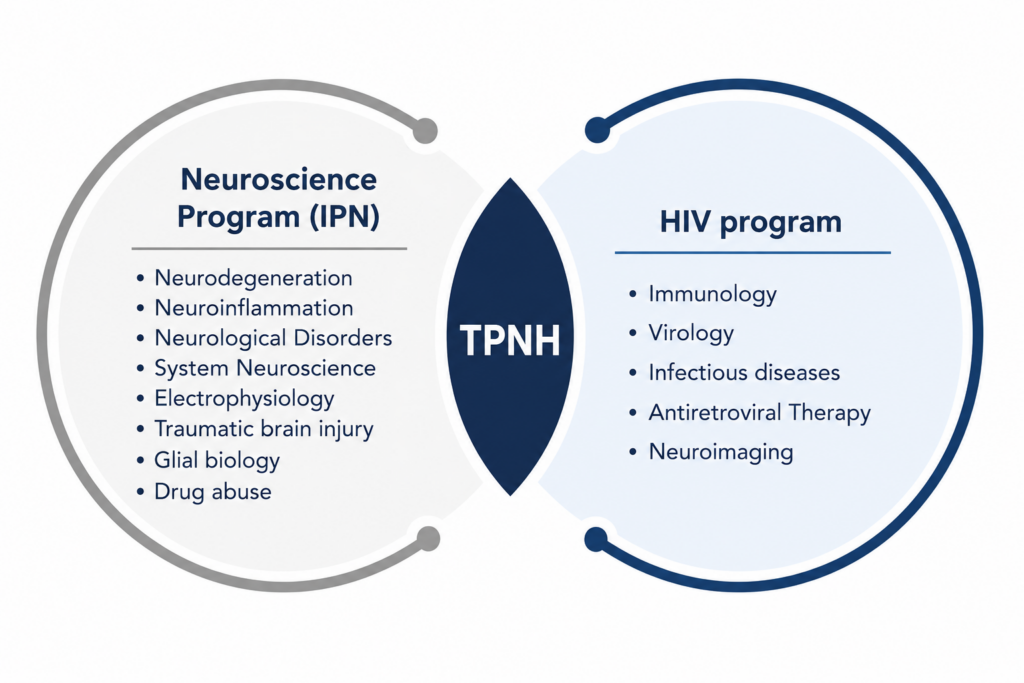
Research projects include gray and white matter degeneration, viral biology, viral proteins, neuroimmunology, neuroinflammation, maintenance of viral reservoirs within CNS glial cells, and substance use disorders. Moreover, trainees gain clinical research exposure through physician-scientists specializing in HAND at GUMC and partnering institutions across the Washington, DC area, including the MedStar Georgetown HIV clinic and the Georgetown site of the MWCCS. These efforts include collaborators at the National Institutes of Health and the DC Center for AIDS Research, which provide specialized expertise and resources to enhance training in the neuropathology and neurological complications of HIV infection.
Participating faculty from different disciplines and departments provide this interdisciplinary approach. Our faculty are heavily involved in predoctoral training and have a history of mentorship.
Predoctoral participants join for Years 3-4. Eligible programs: Biochemistry and Molecular & Cellular Biology, Biology, Biostatistics, Interdisciplinary Program in Neuroscience, Medicine, Microbiology & Immunology, Neurology, Pharmacology & Physiology, Tumor Biology
The primary goal of this Training Program in NeuroHIV T32 is to prepare trainees to transition to independent research positions. Our trainees are encouraged to explore their career options and align their scientific development with their professional goals. Each trainee works with their mentor to prepare an Individual Development Plan (IDP) upon entering the program. The IDP is intended to help trainees identify their career goals and the strengths and weaknesses of their research. The TPNH co-directors are assisting with this process. In addition, the Office of Career Strategy and Professional Development (CSPD), directed by Drs. Caleb McKinney and Elizabeth Salm, within the Biomedical Graduate Education at Georgetown University, offers several professional advice sessions to present and discuss career opportunities and evaluate career options. CSPD also provides an annual workshop for trainees to review the IDP process to identify campus resources pertinent to their professional development. In addition, we encourage our students to utilize the Science Careers myIDP instrument to further self-assess and explore scientific career options. Lastly, students in our graduate programs utilize the NIH career fair for more exposure to their career goals.
All trainees participated in the TPNH specific training opportunities detailed in the Program Plan, which include the: TPNH/CNIR/NIP Journal Club with the additional ethics component, clinical experience with shadowing, meeting/conference presentations, seminars, “Bring it to the Table” monthly meetings, professional development opportunities (i.e., writing workshop, elevator pitch), and enhanced discussions of rigor and experimental design. Scientific literacy was promoted throughout the training period. Since our trainees are in their thesis research years (3rd and 4th), they do not take additional coursework. To increase their knowledge, students participate in workshops on HIV, immunology and neurodegeneration.
Additional training opportunities for oral presentations included presentations at scientific meetings. For the last five years, trainees participated on a semiannual basis in at least two national scientific meetings. One meeting is the “annual neuroHIV retreat”, hosted by NIH/NINDS as detailed in the Program Plan, and one at the District of Columbia Center for AIDS Research (DC CFAR) research day, hosted either by George Washington University or American University, both in D.C. Partnering with DC CFAR seems to enrich students’ experiences and perspectives. With DC CFAR we are continuing to organize a “retreat” day, in which each trainee will present and discuss their data. Again, students are commenting on this experience as “let’s do it again”.

Supported by NIH T32 NS121780
Italo Mocchetti, PhD
Professor, Department of Neuroscience
moccheti@georgetown.edu
Marta Catalfamo, PhD
Associate Professor, Department of Microbiology & Immunology
mc2151@georgetown.edu