

Current Trainees
Alec Gamboa, MS
Alec entered the IPN in 2023 and was appointed to the TPNH in July 2025. He is mentored by Dr. Italo Mocchetti (molecular mechanism of HIV-mediated neurodegeneration) and co-mentored by Dr. Katherine Maguire-Zeiss (neurobiology of glial cells). His research project involves oligodendrocyte pathology in HAND. In particular, how viral proteins impair the survival of oligodendrocytes.
During the year as a T32 mentee, Alec has received training in histology, animal treatment, tissue cultures, animal MRI, and electron microscopy. As a result of his TPNH training, Alec obtained preliminary data on gp120 and oligodendrocyte apoptosis, and applied in January 2026 for an F31 NRSA to study the effect of HIV on white matter.
Alec attended the annual SfN meeting in 2025. In 2026 he attended the NIH Neuro-HIV workshops at NIH/NIDS, and the annual meeting of SNIP. Alec has a published manuscript of his research rotation and one submitted under review.
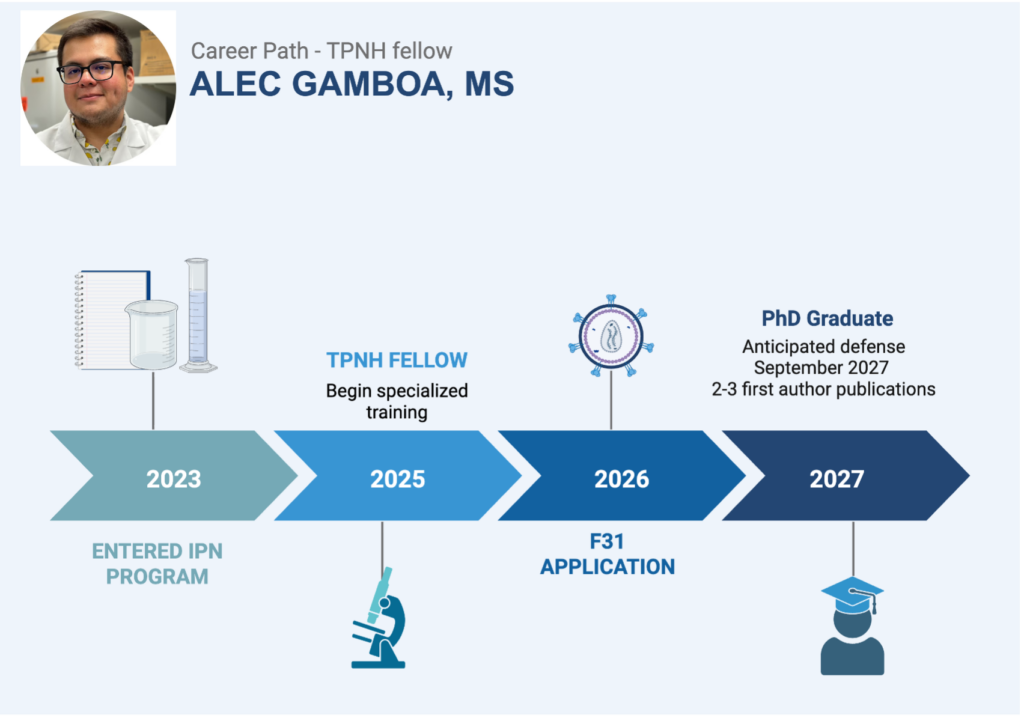
Alec joined the IPN in the summer of 2023. After three rotations and passing the qualifying exam, he began his thesis research in the lab of Drs. Mocchetti and Maguire-Zeiss, and in 2025 began his training as a TPNH Fellow. His graduation is expected for Summer 2028. He is looking for a postdoctoral position in an academic setting.
Presentations
Intramural. Alec presented his thesis work at two seminar talks at GU. These experiences gave him the opportunity to discuss his data with other researchers and share and receive advice for experimental optimization and data analysis. In April 2026, he presented a poster at the research day organized by GU Center for Neural Injury and Recovery of function.
Extramural. Alec presented a poster in 2025 at the SfN annual meeting, as well as a poster at the annual SNIP meeting (2026).
Abbas Hussain
Abbas Hussain, MS, entered the Pharmacology & Physiology program in 2023 and was appointed to the TPNH in July 2026. He is mentored by Dr. Patrick Forcelli (cellular senescence in HIV-mediated neurodegeneration). His research project involves elucidating the role of cellular senescence in the progression of HAND using multiple transgenic mouse models. In particular, how senolytic drug treatment impacts cognitive performance that correlates to underlying changes at the cellular and molecular level.
As a result of his TPNH training, Abbas has generated preliminary data on the time course of senescent cell progression in tg26 and gp120tg mouse models as well as behavioral data indicating normalized cognitive performance in gp120tg mice that received senotherapy.
Abbas plans to attend SFN in 2026 and present his research at a poster session. He will also be presenting his research at the NIH NeuroHIV workshops at NIH/NIDS. Abbas’ research project stems from his previous work on cellular senescence in epilepsy models in the Forcelli lab, where he contributed to multiple published manuscripts.
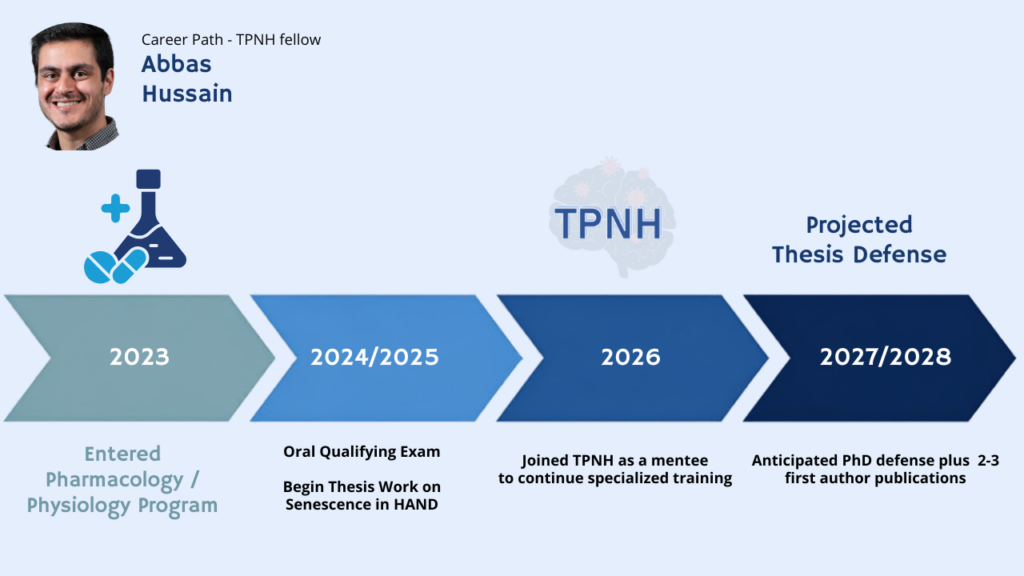
Synopsis of career path of Abbas Hussain as a current TPNH trainee: Abbas joined the Pharmacology/Physiology program in the summer of 2023. After three rotations and passing the qualifying exam, he began his thesis research in the lab of Dr. Forcelli and in 2026 began his training as a TPNH Fellow. His graduation is expected for Winter 2027. After completing his PhD, he is seeking a postdoctoral position in an academic setting after completing his PhD.
Cooper James
Cooper entered the microbiology PhD program in 2023 and was appointed to the TPNH in July of 2025. He is currently in the 4th year of his PhD under the mentorship of Dr. Marta Catalfamo. His research project explores granzyme as mediators of inflammation in people living with HIV, hoping to identify them as one of the missing links that causes people with HIV to have increased immune–activation, inflammation and HIV associated illnesses like cardiovascular disease and HAND. He is also working on a project in collaboration with the Mocchetti lab utilizing their GP120 transgenic mouse model to determine the role of T cell immune activation and neuroinflammation in the brain in the context of HIV infection.
Cooper has attended neurobiology and immunology courses and seminars to cement neurobiology concepts and to understand the complex interplay of the immune system and the brain. He attended the annual NIH Neuro-HIV workshops at NIH/NINDS, in March 2026 to expand his knowledge on neuroHIV and attended the DCCFAR Advanced Technology Core meeting where his work on Gp120 Tg mice and granzymes. He has also been a mentor in the Georgetown OSAM mentor program for 3 years.
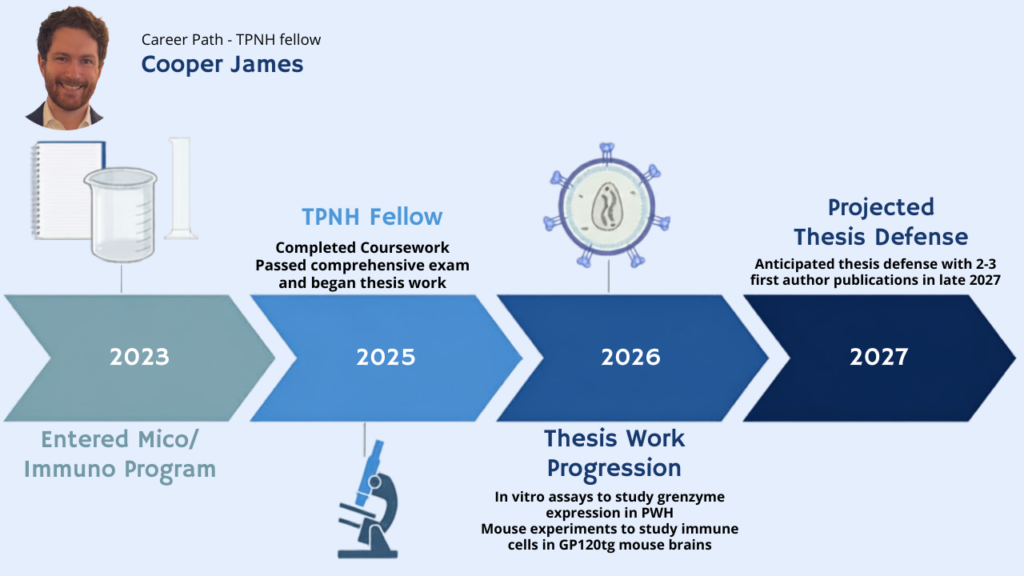
During his TPNH year, Cooper received training in neurobiology of drug addiction, immune cells, flow cytometry, inflammation in the context of HIV, primary cell culture, cytokine and chemokine biology and animal model use.
Presentations:
Intramural: Cooper presented his first thesis talk at the weekly seminar in the Microbiology and Immunology department. He also authored two posters at the annual DCCFAR Advanced Technology Core research day one which he presented his thesis work on granzymes and the other was presented by a masters student under his mentorship and was on his current work studying T cell involvement in HAND.
Publications
Li T., Mehta C., James C., Chen J., Chen H., Ahern G.P., Zhu Z., Cid M.F., Abdussamad M., Yu S., Kumar J., Kumar P., Hadigan C., DiVito K., McGavern D.B., Pobezinsky L., Catalfamo M. (2025) Angiogenic CD8 T cells from PWH induce Granzymes-dependent PAR1 activation promoting endothelial inflammation. bioRxiv 22:2025.08.06.668764. doi: 10.1101/2025.08.06.668764.PMCID: PMC12478364
Li, T., Hadigan C., Ahn J., Mehta C., Mahmood D., Ozdemirli M., James C., Kumar P., Catalfamo M. (2024) Chronic endothelial inflammation in PWH leads to reduced circulating megakaryocyte progenitor cells” Blood: Vessels, Thrombosis and Hemostasis. https://doi.org/10.1016/j.bvth.2024.100039