

Previous Trainees
Maryam Abdussamad
Maryam entered the PhD program in tumor biology in 2020, was appointed to the TPNH in July 2022, was reappointed in July 2023, and graduated in July 2025. She was trained under Dr. Marta Catalfamo’s guidance to study the role of IL-27 in modulating the HIV-specific CD4T and CD8 T cells function. IL-27 has been proposed to cause non-AIDS defining illnesses, including cancer and cardiovascular disease, that promote HIV-associated neurocognitive disorder. She received training in chronic immune activation and systemic inflammation, high-parameter imaging mass cytometry, cytokine and chemokine biology, cell culture, mRNA determination and viral inhibition.
Maryam attended the annual NIH Neuro-HIV workshops at NIH/NINDS in 2023 and 2024 and the T32 director meeting in Philadelphia. In June 2024, she attended a workshop on single-cell RNA seq organized by GUMC.
TPNH requirements
Maryam took a neurobiology class with IPN students to improve her neuroscience background. In addition, she was a regular attendee in the Neuroscience Seminar series related to Neurologic Disorders.
Publications
- Li T, Smith M, Abdussamad M, Katz G, Catalfamo M. (2023) A flow-cytometry-based assay to assess granule exocytosis and GZB delivery by human CD8 T cells and NK cells. STAR Protocols. 4(1), 101939.
- Abdussamad M, Katz G, Cheng J, Mehta C, Andres-Martin F, Mahmood D, Kumar P, Catalfamo M. (2025) IL-27 effects on HIVGag-specific CD4 and CD8 T cell function. Front Virol. 5:1600802. doi: 10.3389/fviro.2025.1600802.PMCID: PMC127006
- Li T., Mehta C., James C., Chen J., Chen H., Ahern G.P., Zhu Z., Cid M.F., Abdussamad M., Yu S., Kumar J., Kumar P., Hadigan C., DiVito K., McGavern D.B., Pobezinsky L., Catalfamo M. (2025) Angiogenic CD8 T cells from PWH induce Granzymes-dependent PAR1 activation promoting endothelial inflammation. bioRxiv 22:2025.08.06.668764. doi: 10.1101/2025.08.06.668764.PMCID: PMC12478364
Presentations
Extramural. Maryam presented a poster at the NINDS T32 workshop in 2023. She also presented her work at the DC CFAR basic science core research day at George Washington University (2024). This was an excellent opportunity to meet other people researching similar topics in the local area and exchange feedback.
Christy Agbey, MS
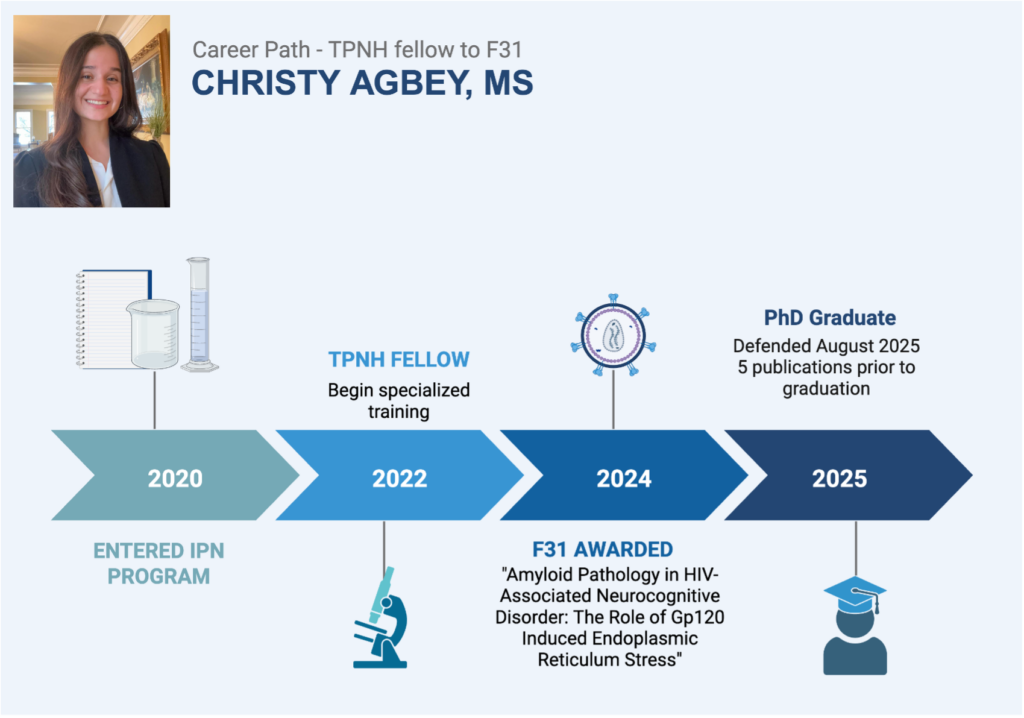
Christy entered the IPN in 2020, was appointed to the TPNH in July 2022, and was reappointed in July 2023. She was mentored by Dr. Italo Mocchetti (molecular mechanism of HIV-mediated neurodegeneration) and co-mentored by Dr. William Rebeck (neurobiology of amyloid). Her research project involved investigating gp120 induced endoplasmic reticulum (ER) stress as a mechanism for increased amyloid beta (Aβ) accumulation in the brain of people living with HIV. She received training in neuronal cytoskeleton, animal treatment, amyloid pathology, calcium imaging and electron microscopy. During her TPNH training, Christy obtained preliminary data on gp120 and amyloid, and applied for and was awarded an F31 NRSA to study the amyloidogenic effect of HIV. She attended two NIH Neuro-HIV workshops at NIH/NIDS, and the Healthy Aging Symposium at GU for the past three years. She attended the annual SfN meeting in 2023, the NINDS T32 workshop in 2023, and the Society for Neuroimmune Pharmacology (SNIP) meeting in 2024. She defended her thesis work in August 2025 (Fig. 2PR).
Publications
- Agbey C., Avdoshina V., Mocchetti I. (2023) Neuronal Cytoskeleton and HIV-Mediated Neurodegeneration. In: Handbook of Neurotoxicity, R.M. Kostrzewa (Ed.). Springer pp 2043-2058.
- Speidell A., Agbey C., Mocchetti I. (2024) Accelerated neurodegeneration of basal forebrain cholinergic neurons in HIV-1 gp120 transgenic mice: Critical role of the p75 neurotrophin receptor. Brain Behav Immun, 117:347-355
- Agbey, C., Walton, S., Campbell, L. A., Nath, A., Smith, B., Snow, J., Ma J., Mocchetti. I. & NIH-Neuro-HIVResearch Consortium (2025) Expression of HIV envelope protein in the human central nervous system. AIDS, 39:788-797.
- Agbey, C., Campbell, L. A., Phan T., Ahern G., Mocchetti. I (2025) Human immunodefiociency virus 1 glycoprotein 120 induces endoplasmic reticulum stress in neurons. Cell Death and Dis 16:704
She is also the first author of a manuscript submitted to Exp Neurology, which is under revision.
Conference Presentations:
Intramural. Christy presented her thesis research at three seminar talks at GU. These experiences gave her the opportunity to discuss her project with researchers in the field, and share and receive advice for experimental optimization and data analysis. In April 2023, she gave a lecture in Topics in Synaptic Transmission class at GU. She presented a poster at the Center for Neural Injury and Recovery research day (Georgetown University, May 2025) and received a 1st place award.
Extramural. Christy presented a poster in 2024 at the Healthy Aging Symposium at GU. She also presented her work at the SfN in 2023 and the 2024 annual SNIP meetings.
Melanie K. Becher
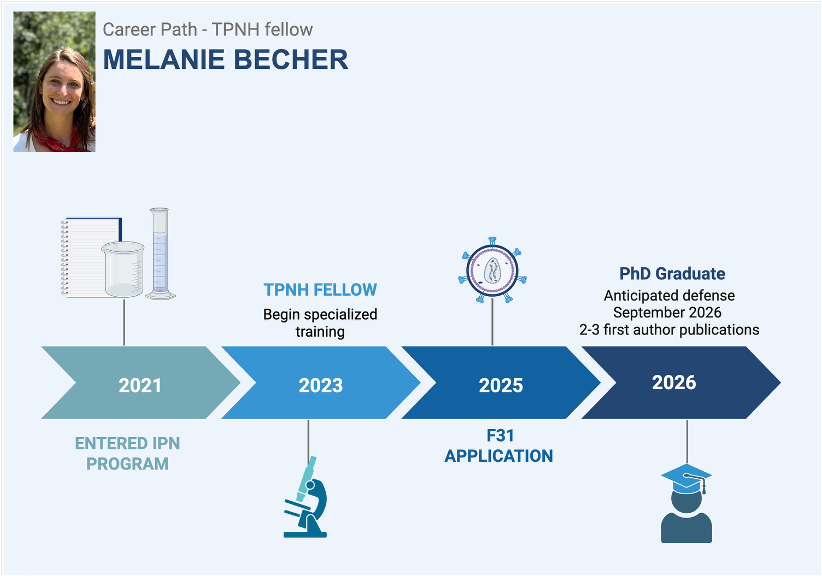
Melanie entered the IPN in 2021 and was appointed to the TPNH in July 2023. She was reappointed for the second year in July 2024. She is currently in her 5th year of PhD in the IPN under the mentorship of Dr. Italo Mocchetti. Her research project explores the role that the low molecular weight isoform of MAP2 play in gp120-mediated toxicity. The neurotoxic effects of gp120 are mostly are seen on dendritic synapses. This is similar to what has been demonstrated in HAND.
She has attended weekly seminars organized by the IPN and Neuroscience department. Additionally, she has attended weekly journal clubs in the “neuronal injury and plasticity” journal club, where she presented a paper once a semester. She attended the annual NINDS T32 workshop in 2024 and 2025.
During her TPNH years, Melanie received training in primary culture, viral vector design and validation, preparation and testing of oligonucleotides targeting specific mRNAs, CRISPR/Cas9, and animal treatment. She recently submitted a F31 NRSA grant. She is on track to defend her thesis in August/September 2026.
Publications
- Becher M.K., Avdoshina V., Campbell L.A., Mocchetti I. (2025) Exploring the potential role of microtubule associated proteins-2 in the pathogenesis of HIV associated neurocognitive disorders. Neurotox Res 43, 19-28.
- Becher, M. K., Wilson, K. and Mocchetti, I. (2026). Using Combined Fluorescent In Situ Hybridization With Immunohistochemistry to Co-localize mRNA in Diverse Neuronal Cell Types. Bio-protocol 16(9): e5591. DOI: 10.21769/BioProtoc.5591
- Becher M.K., Knox T., Wilson K., Kromer L.K., Mocchetti I. (2026) Anatomical and neuronal distribution of the G-coupled protein receptor 75 mRNA in the mouse central nervous system. Eur. J Neurosci, 63, 4, e70441
Conferences Presentations
Intramural. She presented a poster titled: Exploring the role of MAP2 in HIV Associated Neurocognitive Disorder, at the Center for Neural Injury and Recovery (Georgetown University, May 2025.):
Extramural. Melanie presented a chalk talk at the T32 training meeting (Omaha, NE) in 2024, and an oral presentation at the TPNH NeuroHIV Workshop (American University, Washington, DC, March 2024). IN 2025, she presented a poster at the Society for Neuroscience (San Diego, CA)
Katelyn Dial, MS
Katelyn entered the Biochemistry PhD program in 2020 and expressed a strong desire to work on a neuroscience related project. After three rotations, Katelyn selected Dr. Katherine Conant as a thesis mentor but her appointment was delayed for health reasons. She was appointed to the TPNH in July 2024 and reappointed for the second year in July 2025. Her research focuses on understanding how selective activation of the serotonin 2A receptor (5HT2AR) affects perineuronal net (PNN) deposition and therefore, neural plasticity. This is an important mechanism that may explain major depressive disorder, which is a clinical sign present in people living with HIV. During her years as a TPNH trainee, Katelyn received training in animal behavior, immunohistochemistry and hippocampal EEG recordings. She received a 2024 student research grant award from Georgetown University, and a 2025 pilot student research grant from Source Research Foundation, Columbus, OH. Her thesis defense is scheduled for March 2027.
TPNH requirements
Because Katelyn is not from the IPN, she attended the basic neuroscience course and the neurobiology of drug addiction course with the IPN students to improve her neuroscience background. In addition, she was a regular attendee in the Neuroscience Seminar series related to Neurologic Disorders. She attended the annual neuroHIV workshop at NINDS and the DC CFAR workshop (both in the Spring semester of 2026) to receive additional training in neuroHIV.
Presentations
Intramural. Katelyn presented her thesis research at the Biochemistry department’s weekly seminar. She also presented her work at the TPNH retreat. Moreover, she presented a poster at the research day annual meeting of the GU Center for Neural Injury and Recovery of Function entitled “Chemokines, CCR5 and depression”.
Extramural. During this training period, Katelyn presented a poster about her research at the Society of Neuroscience annual meeting in Chicago, IL. She presented a poster at the 2025 Gordon conference on Bridging Molecular and Synaptic Mechanisms to Behavior and Therapeutic in Smithfield, RI.
Karli F Gilbert
Karli entered the IPN in July 2018 and was appointed to the TPNH in July 2021. She was reappointed in 2022 and earned her PhD in 2024. She was mentored by Drs. Katherine Conant. Her thesis project characterized neuroimmune responses attributed to astrocytes, and, in particular, the role of senescent in motor neurons loss. Karli attended Georgetown-sponsored events including career development symposiums focused on “Transferable Skills” and “Career Options” as well as departmental seminars/journal clubs for both the Pharmacology and Neuroscience Departments. She also attended two NIH Neuro-HIV workshops at NIH/NIDS (2021 and 2022).
Karli organized and attended the Medical Center Graduate Student Organization’s Student Research Day on October 28, 2021. This yearly intra-university conference is an important opportunity for Georgetown University doctoral students to showcase their research, practice their presentation skills, and receive critical feedback from faculty judges. In the Fall of 2021, Karli was a course director for a combined undergraduate and master’s student (NSCI-425) course titled: Topics in Neuroscience: Brain Diseases, Research, and Treatment.
Karli received training in animal behavior, pro-inflammatory cytokines, perineuronal net, and MMPs. She is now working as a Senior Research Associate at George Washington University, D.C.
Publications
Gilbert KF, Amontree M, Deasy S, Ma J, and Conant K (2024) Pramipexole, a D3 receptor agonist, increases cortical gamma power and biochemical correlates of cortical excitation; implications for mood disorders, Eur J Neurosci, 60(10): 6490–508.
Presentations
Intramural. In addition to presenting her thesis research at three seminar talks at GU, Karli presented at theMedStar Health-Georgetown University Research & Education Symposium in May 2023.
Extramural. Karli presented posters at the Psycho-Neuro-Immunology Research Society (PNIRS) Conference, June 16th, 2022, in Zürich, Switzerland, and the Society for Neuroscience (SFN) Conference, November 15th, 2022.
Honor
Karli was awarded a Medical Center Graduate Student Organization (MCGSO) Professional Development Award ($800) on October 11th, 2022, to fund travel expenses to the SFN conference. Additionally, she won 1st place in oral presentations for MCGSO Student Research Day on October 6th, 2022, judged by Georgetown University faculty and postdoctoral fellows (cash prize $250).
Griffin A. Greco
Griffin entered the PhD program in Pharmacology in July 2018 and was enrolled in the TPNH in July 2021. He was mentored by Drs. Katherine Conant and Kathleen Maguire-Zeiss. He was reappointed in July 2022 and earned his PhD in 2023. His thesis project characterized the role that chemokine receptors, and in particular CCR5, plays in working memory. He was investigating the hypothesis that the APOE4 allele is linked to dysregulation of extracellular matrix deposition and proteolysis, and that this imbalance results in cognitive and electrophysiological deficits. In October 2021, Griffin attended the National Institute of Mental Health (NIMH) conference entitled “Macrophage Infection by HIV: Implications for Pathogenesis and Cure”. In March 2022, he attended the annual neuroHIV meeting at NIH/NINDS. Griffin assisted in hosting Dr. Howard Fox to present a seminar on “Neuropathogenic Microglia: Single Cell Analysis in HIV/SIV, ART, and Drug Abuse”. Griffin received training in chemokines and neuroinflammation, animal electroencephalography, genetic factors, KO mice, and human subjects. Griffin is now working as a research consultant at Castlemaine Consulting.
Publications
- Greco GA, Rock M, Amontree M, Lanfranco MF, Korthas H, Hong SH, Turner RS, Rebeck GW, Conant K. (2023) CCR5 deficiency normalizes TIMP levels, working memory, and gamma oscillation power in APOE4 targeted replacement mice. Neurobiol Dis, 179:106057.
- Deasy S, Amontree M, Colon Z, Thorland E, Modi K, Hummel K, Blanco I, Greco G, Maguire-Zeiss K, Conant K., 2025, Increased levels of HAPLN2, which anchors dense extracellular matrix, in the hippocampus of APOE4 targeted replacement mice, bioRxiv, 2025.11.09.687435
Presentations
Intramural. Griffin presented his thesis research at three seminar talks at GU.
Extramural. Griffin gave an oral presentation at the DC CFAR basic science Core Research Day in August 2022 and presented a poster at the SfN annual meeting in 2022.
Matthew Nelson, MS
Matthew entered the IPN in 2021, and he was appointed to the TPNH in July 2023. He was reappointed for the second year in July 2024. He is currently in his 5th year of PhD in the IPN Program under the mentorship of Dr. Kathleen Maguire-Zeiss. Matthew’s thesis is focused on changes in astrocyte function in response to pathogenic alpha-synuclein and the HIV protein TAT. Additionally, he is testing the hypothesis that TAT induces the release of pro-inflammatory microglia derived extracellular vesicles.
Matthew received training in primary cell culture, viral proteins, proteomic and RNA sequence, extracellular vesicles, and microscopy. He attended the NINDS T32 workshops in 2024 and the NIH Neuro-HIV workshop at NIH/NINDS in 2025 and 2026. His thesis defense is planned for June 2026.
Publications
Amontree M., Nelson M., Stefansson L., Pak D., Maguire-Zeiss K., Turner R.S., Conant K. (2024) Resveratrol differentially affects MMP-9 release from neurons and glia; implications for therapeutic efficacy. J Neurochem, 168(9):1895-1908. doi: 10.1111/jnc.16031. Epub 2024 Jan 1. PMID: 38163875.
He has a first author paper on microglia and vesicles submitted to J. Neuroscience.
Presentations
Intramural. Matthew presented his thesis research at our weekly neuro-seminar in the fall of 2023 and 2024 to the IPN. In May of 2025, he presented a talk on extracellular vesicles at the annual Neuro-Research symposium at GUMC.
Extramural. Matthew presented a poster in 2024 at the NINDS T32 workshop. Also, he attended the 2024 Society for Neuroscience conference and presented his research poster on the effects of extracellular vesicles on glia activation and inflammation. He attended and presented his research in September at the 2024 NeuroHIV Training Symposium at American University.
Anna C. Pearson
Anna was appointed to the TPNH in July 2024 and reappointed in July 2025. She is currently in her 4th year of PhD in neuroscience. Her current mentors are Drs. Alexey Ostroumov and Patrick Forcelli, both IPN mentors from the Department of Pharmacology. Her thesis project is:” Understanding the role of the ion cotransporter KCC2 in behaviors associated with opioid use disorder and HIV. Anna has actively participated in all TPNH events (e.g., seminars and journal club) and workshops (e.g., Dr. Ming Tang’s lecture on experimental design). Anna completed the course in responsible conduct of research and skills development (written and oral presentations) and the rigor and transparency training. She has recently submitted a F31.
Anna served as Course Director for the IPN Summer Course in 2024, helping redesign the curriculum and teaching core lectures. She also led sessions in the Critical Readings course. She was nominated IPN Student Body President (2024–2025), and she gained experience in event coordination, student advocacy, and academic leadership, preparing her for a career in academia.
Anna received training in ex vivo electrophysiology, animal treatment, opioid research, GABAergic neuron pharmacology, and risk factors for HIV transmission. She plans to defend her thesis in 2027.
Publications
- Pearson, A. C., Ostroumov, A. (2024). Midbrain KCC2 Downregulation: Implications for stress-related and substance use behaviors. Curr Opin Neurobiol, 88,102901 doi: 10.1016/j.conb.2024.102901. PMCID: PMC11392611
- Pearson A.C., Kimmey B.A., Taormina M.B., Holden W.M., Ostroumov A. (2025) Cocaine and Morphine Converge to Disrupt Chloride Homeostasis in Ventral Tegmental Area GABA Neurons. Addict Biol. 30(12):e70104. doi: 10.1111/adb.70104. PMCID: PMC12678199.
Presentations
Intramural. Anna presented a poster at the annual Georgetown Student Research Day, and a seminar at the annual IPN seminar in Summer 2024. She also led a journal club discussion on comorbidities, HIV, and cocaine use.
Extramural. During this training period, Anna gave an oral presentation about her research at the District of Columbia Center for AIDS Research Aging & Comorbidities Special Working Group’s (DC CFAR A&C SWG) NeuroHIV Training Symposium, hosted at American University in Washington, DC. This was an excellent opportunity to meet other people researching similar topics in the local area. Through this presentation, she was able to gain valuable experience in discussing her research to a more general audience of the scientific community.